
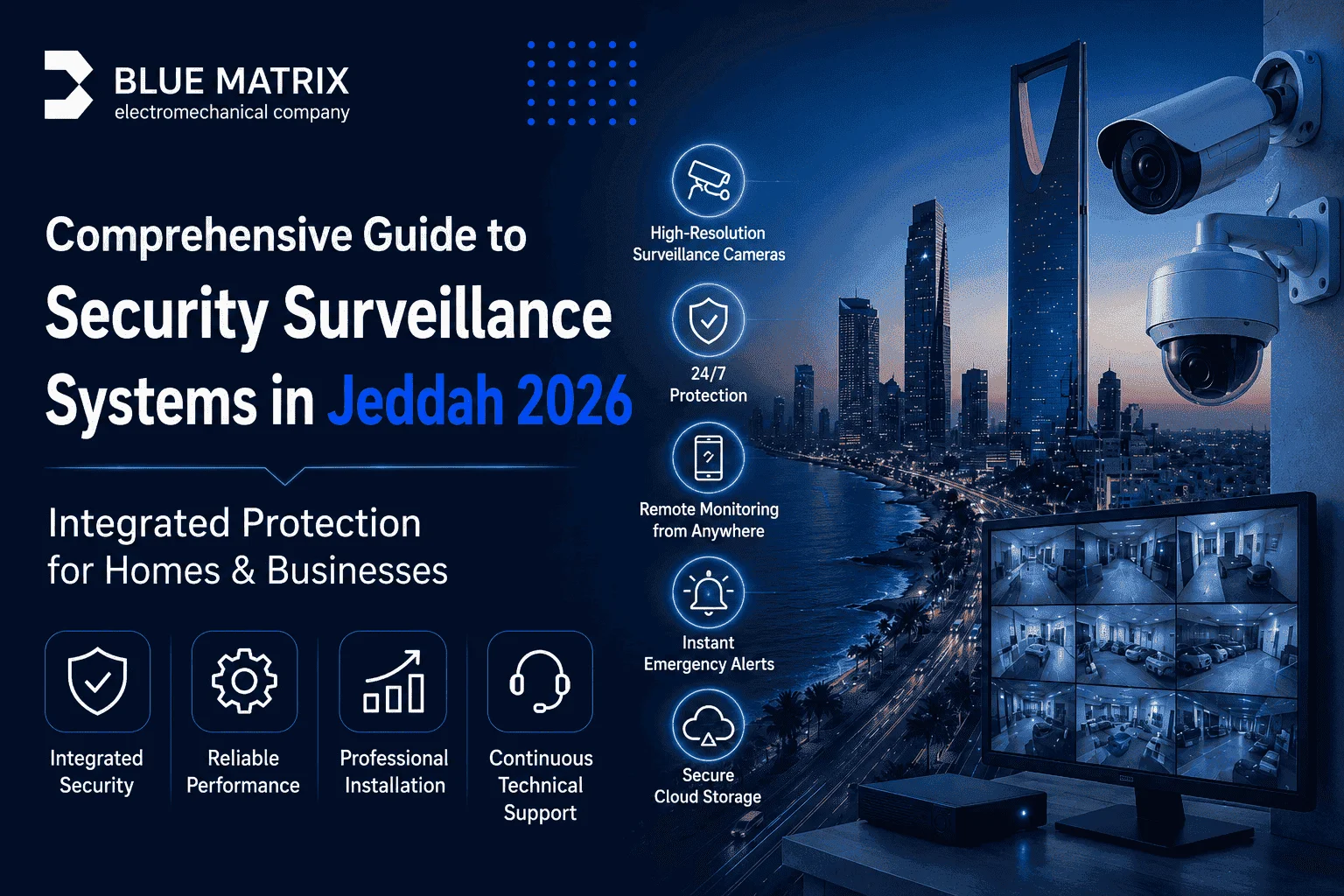
Security is no longer an optional add-on for modern organizations it has become a fundamental part of business continuity and asset protection. That is why many companies in Jeddah rely on smart security surveillance systems to ensure a safer and more efficient environment.
In this comprehensive guide, we will review everything related to security surveillance systems in Jeddah, from modern technologies to international standards, through the importance of integration with Communication Systems and Smart Building Systems, all the way to how to choose the right partner to implement these systems.
Quick Overview of the Security Surveillance Market in Saudi Arabia
The security surveillance market in the Kingdom of Saudi Arabia is witnessing tremendous growth. The CCTV camera market in the Kingdom is estimated at billions of riyals, and this figure is expected to double in the coming years at a compound annual growth rate exceeding 10%. This growth is driven by several key factors:
- Saudi Vision 2030: Aiming to develop digital infrastructure and smart cities.
- NEOM and Economic City Projects: Requiring the highest security and safety standards.
- Digital Transformation: Increasing awareness among companies about the importance of protecting data and assets.
- Civil Defense Requirements: Imposing strict standards for alarm and surveillance systems in commercial buildings.
In Jeddah specifically, the need is increasing for integrated surveillance systems covering high-definition CCTV cameras, access control systems, and anti-theft and fire alarm systems, with the ability to integrate with smart building systems to manage everything from a single centralized interface.
What Are Integrated Security Surveillance Systems?
Integrated security surveillance systems are a set of connected technical systems that work together to provide comprehensive protection for buildings and facilities. These systems are not limited to surveillance cameras only, but include an integrated network of security and technical solutions:
Key Components of an Integrated Security Surveillance System
Table
| System | Function | Importance for Companies |
| CCTV Surveillance Cameras | Video recording and monitoring 24/7 | Detecting suspicious activities and providing legal evidence |
| Access Control Systems | Managing who enters and exits the building | Protecting sensitive areas and tracking employee movement |
| Intrusion Detection Systems | Detecting break-ins and trespassing | Immediate alert when security boundaries are breached |
| Fire Alarm Systems | Early smoke and heat detection | Protecting lives and property per Civil Defense requirements |
| Intercom Systems | Audio and visual communication between points | Verifying visitor identity before granting access |
| Building Management System (BMS) | Centralized control of all systems | Integrated management from a single screen |
The power of these systems lies in the integration between them. When surveillance cameras connect to access control systems, and are linked to Communication Systems through a unified network, the building transforms into a smart facility capable of automatically responding to threats.
1. CCTV Surveillance Cameras: The Eyes That Never Sleep
CCTV surveillance cameras are the cornerstone of any integrated security system. With the massive technological advancement, cameras are no longer just recording devices they have become smart tools capable of analysis and prediction.
Types of Modern Surveillance Cameras
- IP Cameras (Network Cameras)
- Provide imaging resolution up to 4K and 8K
- Connect directly to the network via Ethernet cables
- Support remote access via mobile phone
- Ideal for large companies and government institutions
- Analog HD Cameras
- Traditional upgrade at a lower cost
- Suitable for small and medium-sized buildings
- Easy to install and maintain
- PTZ Cameras (Pan-Tilt-Zoom)
- Controllable direction and zoom
- Ideal for covering wide areas
- Used in warehouses, parking lots, and open areas
- Dome and Bullet Cameras
- Dome: Concealed and ideal for indoor ceilings
- Bullet: Visible and deterrent for outdoor areas
Artificial Intelligence Technologies in Surveillance Cameras
Modern surveillance cameras are now powered by Artificial Intelligence (AI), providing revolutionary features:
- Facial Recognition: Automatically identifying individuals and comparing them with databases
- Suspicious Behavior Detection: Recognizing abnormal movements (running, trespassing, gatherings)
- Real-Time Video Analytics: Sending immediate alerts when a threat is detected
- Automatic People Counting: Calculating the number of people in designated areas
- License Plate Recognition (ANPR): For monitoring vehicle movement
These technologies reduce false alarms by up to 90%, and help security teams focus only on real threats.
2. Access Control Systems: Protecting Sensitive Areas
After surveillance cameras, access control systems come as the second line of defense. These systems control who can enter specific parts of the building, when, and where.
Types of Access Control Systems
- Fingerprint Systems
- The most secure and accurate
- Cannot be forged or copied
- Ideal for highly sensitive areas (server rooms, laboratories, vaults)
- Smart Card Systems
- Easy to issue and cancel
- Can be programmed for specific areas
- Suitable for employees and visitors
- Facial Recognition Systems
- Fast and touchless
- Ideal in post-pandemic conditions
- Integrate with surveillance cameras
- Keypad + PIN Systems
- Simple and low-cost
- Suitable for medium-security areas
Why Do Companies Need Access Control Systems?
- Track Employee Movement: Knowing who entered, when, and where they went
- Protect Data: Preventing unauthorized access to server rooms
- Visitor Management: Issuing temporary cards with limited permissions
- HR Integration: Linking entry to work hours and attendance records
3. Alarm and Intrusion Detection Systems
Alarm systems are the first line of defense against threats. When a break-in or fire is detected, the system must be able to alert immediately.
Intrusion Detection Systems
These include:
- PIR Motion Detectors: Detecting movement in enclosed areas
- Door and Window Sensors: Alerting when any entry point is opened
- Glass Break Detectors: Detecting glass vibration
- Underground Intrusion Detectors: For areas surrounding the building
Fire Alarm Systems
According to Saudi Civil Defense requirements, all commercial buildings must install:
- Smoke Detectors
- Heat Detectors
- Manual Call Points
- Automatic Sprinkler Systems
- FM200 Systems for sensitive areas (server rooms, libraries)
All of these systems must be Civil Defense approved and compliant with NFPA international standards.
4. Intercom Systems: Smart Communication with Visitors
Intercom systems enable audio and visual communication between entry points and internal offices. In large companies:
- Employees can verify visitor identity before granting access
- They integrate with surveillance cameras to see the visitor
- They support communication between different floors
- IP versions connect via internal Communication Systems
5. Integration with Smart Building Systems (BMS)
The greatest strength of security surveillance systems lies in their integration with Smart Building Systems. When security systems are connected to a Building Management System (BMS):
- Centralized Control: Managing security, HVAC, and lighting from a single screen
- Automatic Response: When a fire is detected, the system automatically opens emergency doors, shuts down air conditioning, and activates emergency lighting
- Energy Savings: Turning off lighting and air conditioning in unoccupied areas
- Smart Reports: Analyzing security and energy data together
This integration transforms the building into a truly smart facility that responds to events automatically without human intervention.
Why Does Jeddah Need Specialized Security Surveillance Systems?
Jeddah has unique geographical and climatic characteristics that require customized security solutions:
Climatic Challenges
- High Temperatures: Requiring heat-resistant cameras (up to 50°C)
- High Humidity: Especially near the sea, requiring corrosion-resistant equipment
- Dust Storms: Requiring cameras with at least IP67 protection rating
Urban Challenges
- High Population Density: Requiring comprehensive coverage of wide areas
- Intense Commercial Activity: Requiring 24/7 monitoring
- Rapid Urban Expansion: Requiring systems scalable for future growth
Regulatory Requirements
- Saudi Building Code: Imposing strict standards for security and safety systems
- Civil Defense Requirements: Mandatory in commercial buildings
- Saudi Standards Organization: Ensuring product quality
How to Choose the Best Company for Installing Security Surveillance Systems in Jeddah?
Choosing the right partner to implement security surveillance systems is a strategic decision that affects your facility’s security for years to come. Here are the most important criteria:
1. Experience and Technical Competence
- A team of engineers certified by the Saudi Council of Engineers
- Proven experience in projects similar to your project’s size and nature
- Deep knowledge of the latest technologies (AI, IoT, Cloud)
2. Compliance with Local and International Standards
- Compliance with Saudi Civil Defense requirements
- Conformance with NFPA and ISO standards
- Certification from the Saudi Standards Organization
3. Integration Capability
- Can the company integrate security systems with Communication Systems and Smart Building Systems?
- Do they use standard protocols like ONVIF for cameras?
4. After-Sales Services
- Periodic maintenance contracts (monthly, quarterly, annual)
- Emergency response 24/7
- Regular software updates
5. Product Quality
- Use of globally approved brand-name products
- Genuine warranties (at least 5 years for cameras)
- Resistance to Saudi climatic conditions
Why Choose Blue Matrix for Security Surveillance Systems in Jeddah?
Blue Matrix is a Saudi company specialized in Mechanical, Electrical, and Plumbing (MEP) works, providing integrated solutions for Low Current Systems including integrated security surveillance systems. We rely on a qualified team of experienced engineers and technicians, and we are committed to providing reliable services that keep pace with changing market requirements.
What Blue Matrix Offers:
Table
| Service | Details |
| Engineering Design | Field study and custom design for each project |
| Supply | Globally approved products compliant with standards |
| Installation | Specialized technical team with Saudi expertise |
| Integration | Connecting security systems with BMS and communications |
| Maintenance | Annual and periodic maintenance contracts with emergency response |
Proven Saudi Expertise
- Deep understanding of Saudi climatic challenges
- Complete knowledge of the Saudi Building Code and Civil Defense requirements
- Project execution in Jeddah and throughout the Kingdom
Comprehensive Integration
We provide integrated solutions that combine HVAC systems, plumbing, firefighting systems, electrical works, and low current systems under one umbrella. This integrated coordination ensures:
- Unified execution quality
- Reduced engineering errors
- On-time delivery
- Lower operational costs
Frequently Asked Questions
What are the best surveillance cameras for companies in Jeddah?
The answer depends on each company’s needs. Generally, we recommend high-definition IP cameras (at least 4K) with AI support, and resistance to heat and humidity (IP67). For outdoor areas, PTZ cameras with infrared night vision are preferred.
Are fire alarm systems mandatory for companies?
Yes, mandatory. According to Saudi Civil Defense requirements, all commercial buildings must install approved fire alarm systems. Non-compliance exposes the company to fines and closure.
What is the cost of installing a security surveillance system for a company?
The cost varies depending on:
- Building size and number of cameras required
- Camera type (Analog vs IP)
- Additional technologies (AI, facial recognition)
- Integration with other systems
Contact Blue Matrix for a customized quote for your project.
Can the building be monitored remotely?
Yes. With modern IP cameras, you can monitor your facility from anywhere in the world via a mobile app. You can also receive immediate alerts when any suspicious activity is detected.
What is the difference between traditional and smart surveillance systems?
Traditional systems rely on recording and manual review, while smart systems use Artificial Intelligence for:
- Real-time analysis
- Automatic alerting
- Reducing false alarms
- Facial and behavioral recognition
Do surveillance systems integrate with smart building systems?
Yes. When integrated withSmart Building Systems BMS, security, energy, and air conditioning can be managed from a single interface, providing unprecedented operational efficiency.
Conclusion
If you’re looking for a company specialized in security surveillance systems in Jeddah, Blue Matrix provides comprehensive solutions including design, supply, installation, and maintenance in accordance with the highest standards approved in Saudi Arabia. Contact us today for a free consultation and a detailed assessment of your project requirements.