
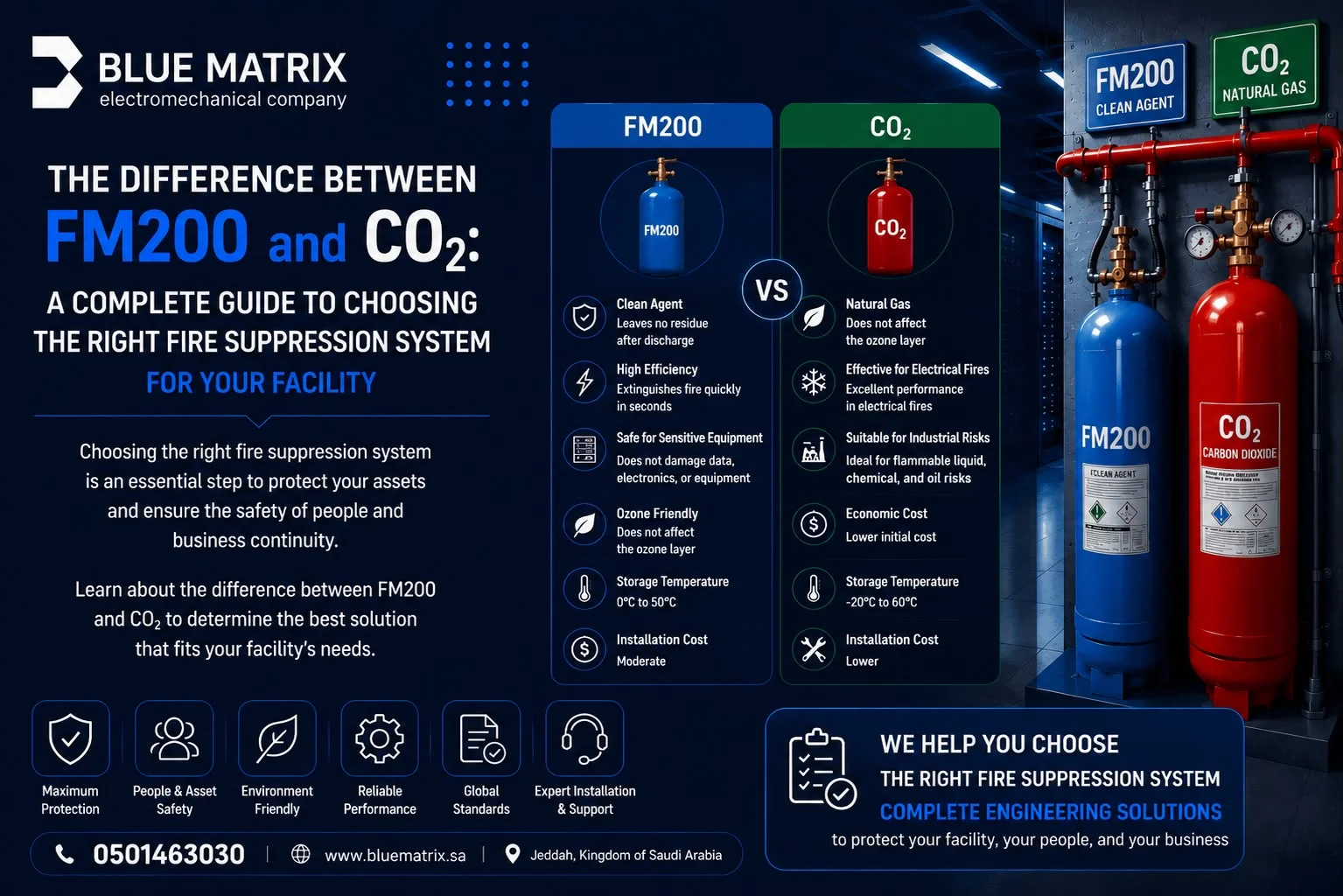
Imagine a fire breaking out in your server room. Water would destroy your data, chemical powders would damage sensitive equipment, and the wrong gas could put someone’s life at risk. This is the real challenge facility managers face when protecting valuable assets. The difference between FM200 and CO2 is not simply the type of gas used. It is the difference between protecting lives and endangering them, and between safeguarding critical assets and causing unnecessary damage.
Introduction: Why Use Gas Fire Suppression Systems?
When protecting sensitive environments such as data centers, electrical rooms, museums, and hospitals, traditional fire suppression methods like water or dry chemical agents often create more damage than the fire itself. Water can ruin electrical equipment and important documents, while chemical powders leave residue that can disable delicate electronics.
This is where Clean Agent Fire Suppression Systems come in. These systems extinguish fires without leaving any residue behind.
However, not every gas is suitable for every application. The difference between FM200 and CO2 extends beyond extinguishing performance to include occupant safety, operating costs, and environmental impact. Selecting the wrong system may either fail to protect valuable assets or put human lives at risk.
FM200 System: The Safe Clean Agent
What is FM200?
FM200 is a clean agent fire suppression system that uses Heptafluoropropane (HFC-227ea) as the extinguishing agent. It is one of the most widely used gaseous fire suppression systems worldwide because it offers an excellent balance between fire protection performance and occupant safety.
How FM200 Works
Unlike CO2, FM200 does not extinguish fire by removing oxygen. Instead, it works through two simultaneous mechanisms:
Heat Absorption
The gas absorbs heat from the flames, reducing the temperature below the level required to sustain combustion.
Chemical Chain Reaction Interruption
FM200 interrupts the chemical reaction responsible for combustion, stopping the fire from continuing.
This allows FM200 to extinguish a fire in less than 10 seconds without reducing oxygen levels to dangerous concentrations.
Advantages of FM200
Safe for Occupied Areas
At design concentrations, FM200 is considered safe for occupied spaces. People inside the protected area can evacuate safely during system discharge, making it ideal for server rooms, control rooms, offices, and other occupied environments.
Residue-Free Protection
FM200 leaves no water, powder, or residue after discharge. Electronic equipment remains clean and can often return to operation after basic ventilation.
Extremely Fast Suppression
Most fires are extinguished in under 10 seconds, minimizing fire damage and business interruption.
Ideal for Sensitive Equipment
FM200 does not react with metals, plastics, or electronic components, making it suitable for data centers, archives, laboratories, and telecommunications facilities.
Compact Storage
FM200 is stored as a liquefied compressed gas, allowing smaller cylinders and reduced storage space compared to many other suppression systems.
Disadvantages of FM200
Environmental Impact
FM200 has a high Global Warming Potential (GWP = 3,350). Because of environmental regulations, many countries are gradually shifting toward more environmentally friendly alternatives.
Higher Cost
Both the gas itself and system recharge costs are generally higher than CO2.
Thermal Decomposition
If exposed to extremely high temperatures during a fire, FM200 can decompose and produce Hydrogen Fluoride (HF), a toxic gas. Proper ventilation is recommended after system discharge.
CO2 System: Powerful but Hazardous
What is CO2?
A CO2 fire suppression system uses Carbon Dioxide as the extinguishing agent. It is one of the oldest gaseous fire suppression technologies and remains widely used in industrial applications due to its effectiveness and relatively low cost.
How CO2 Works
CO2 suppresses fire through a single but highly effective mechanism:
Oxygen Displacement
The gas reduces oxygen concentration inside the protected area to below approximately 15%, preventing combustion from continuing. It also provides limited cooling during discharge.
The problem is that the same oxygen concentration required to extinguish the fire is also dangerous for humans. Typical CO2 design concentrations (34–72%, depending on the hazard) are well above levels considered safe for human exposure.
Advantages of CO2
Highly Effective Fire Suppression
CO2 rapidly extinguishes flammable liquid fires and electrical fires.
No Residue
Like FM200, CO2 leaves no residue after discharge.
Low Cost
Carbon dioxide is widely available and significantly less expensive than most clean agents.
Excellent for Deep-Seated Fires
CO2 performs better than FM200 in suppressing deep-seated fires involving combustible solids.
Disadvantages of CO2
Serious Risk to Human Life
This is the primary disadvantage of CO2 systems.
The concentration required for fire suppression can cause unconsciousness within seconds and death within minutes.
The U.S. Environmental Protection Agency (EPA) states that the CO2 concentration necessary for extinguishing fires greatly exceeds safe human exposure levels, leaving virtually no margin for error. Fatal accidents involving accidental CO2 discharge continue to occur worldwide.
High Operating Pressure
CO2 is stored at approximately 150–200 bar, compared with only 25–42 bar for FM200. This requires stronger cylinders and piping systems while increasing mechanical risks if equipment fails.
Extreme Cooling During Discharge
When liquid CO2 rapidly expands into gas, it creates extremely low temperatures that may damage sensitive equipment or cause ice formation inside piping.
Mandatory Ventilation
Following discharge, the protected area must be thoroughly ventilated before personnel are allowed to enter, resulting in longer operational downtime.
FM200 vs. CO2: A Complete Guide to Choosing the Right Fire Suppression System
Imagine a fire breaking out in your server room. Water would destroy your data, chemical powders would damage sensitive equipment, and the wrong suppression gas could even put lives at risk. This is the real challenge every facility manager faces when protecting valuable assets. The difference between FM200 and CO2 is not simply the type of gas used—it can mean the difference between protecting lives and endangering them, or preserving critical equipment and losing it.
Why Choose Gas Fire Suppression Systems?
When protecting sensitive environments such as data centers, electrical rooms, museums, hospitals, and archives, traditional fire suppression systems using water or dry chemicals often cause more damage than the fire itself. Water can destroy electrical equipment and important documents, while chemical powders leave residues that damage precision electronics.
This is where Clean Agent Fire Suppression Systems become the ideal solution. They extinguish fires quickly without leaving any residue.
However, not every gas is suitable for every application. The difference between FM200 and CO2 extends beyond extinguishing performance to include occupant safety, operating costs, and environmental impact. Choosing the wrong system may either fail to protect your assets or place human lives at serious risk.
FM200 Fire Suppression System: The Safe Clean Agent
What is FM200?
FM200 is a clean agent fire suppression system that uses Heptafluoropropane (HFC-227ea) as its extinguishing agent. It is one of the most widely used gaseous suppression systems worldwide because it offers an excellent balance between effectiveness and occupant safety.
How FM200 Works
Unlike CO2, FM200 does not extinguish fires by removing oxygen. Instead, it works through two simultaneous mechanisms:
- Heat Absorption: Removes heat from the flames, lowering the temperature below the combustion threshold.
- Chemical Chain Reaction Interruption: Interrupts the combustion process by stopping the chemical reaction between fuel and oxygen.
This enables FM200 to extinguish fires in less than 10 seconds without reducing oxygen to dangerous levels for occupants.
Advantages of FM200
Safe for Occupants
At its design concentration, FM200 poses minimal risk to human health. People inside the protected area can safely evacuate while the system discharges, making it ideal for:
- Server rooms
- Data centers
- Control rooms
- Offices
- Hospitals
- Banks
Residue-Free Protection
FM200 leaves no water, powder, or residue after discharge. Electronic equipment remains clean and can often resume operation shortly after ventilation.
Extremely Fast Suppression
The system extinguishes fires in under 10 seconds, significantly reducing damage.
Protects Sensitive Equipment
FM200 is non-corrosive and does not react with metals, plastics, or electronic circuits, making it suitable for:
- Data centers
- Archives
- Laboratories
- Telecommunications rooms
Compact Storage
FM200 is stored as a liquefied compressed gas, requiring relatively small storage cylinders compared to many other suppression systems.
Disadvantages of FM200
Environmental Impact
FM200 has a relatively high Global Warming Potential (GWP = 3,350). Many countries are gradually transitioning toward more environmentally friendly alternatives.
Higher Cost
Both the initial installation and cylinder refilling costs are generally higher than CO2 systems.
Thermal Decomposition
Under extremely high fire temperatures, FM200 can decompose and produce hydrogen fluoride, a toxic gas. Proper ventilation after discharge is therefore recommended.
CO2 Fire Suppression System: Powerful but Hazardous
What is CO2?
CO2 fire suppression systems use carbon dioxide as the extinguishing agent. They are among the oldest gaseous suppression technologies and remain widely used in industrial facilities due to their effectiveness and relatively low cost.
How CO2 Works
CO2 suppresses fire by reducing oxygen concentration.
The system lowers oxygen levels below approximately 15%, preventing combustion while also providing limited cooling.
The major drawback is that the same concentration required to extinguish a fire is also dangerous to humans. Fire suppression concentrations typically range from 34% to 72%, well above levels considered safe for human exposure.
Advantages of CO2
High Fire Suppression Performance
CO2 is particularly effective against:
- Flammable liquid fires
- Electrical fires
No Residue
Like FM200, CO2 leaves no residue after discharge.
Lower Cost
Carbon dioxide is inexpensive and readily available.
Excellent for Deep-Seated Fires
CO2 often outperforms FM200 in extinguishing deep-seated fires involving solid combustible materials.
CO2 Disadvantages: Significant Safety Risks
Life-Threatening to Occupants
This is CO2’s greatest disadvantage.
The concentrations required for fire suppression can cause unconsciousness within seconds and death within minutes. According to the U.S. Environmental Protection Agency (EPA), fire suppression concentrations greatly exceed lethal exposure levels, leaving virtually no margin for human safety.
Accidental CO2 discharges continue to result in fatalities worldwide.
High Operating Pressure
CO2 is stored at approximately 150–200 bar, compared to 25–42 bar for FM200.
This requires:
- Heavier cylinders
- Stronger piping
- More robust system components
Extreme Cooling
When discharged, liquid CO2 rapidly expands into gas, creating intense cooling that may damage sensitive equipment or cause ice formation inside piping.
Mandatory Ventilation
Protected areas must be thoroughly ventilated before re-entry, increasing downtime after system activation.
FM200 vs. CO2: Complete Comparison
| Criteria | FM200 | CO2 |
| Extinguishing Method | Heat absorption + chemical interruption | Oxygen displacement |
| Occupant Safety | Safe at design concentration | Dangerous at design concentration |
| Suppression Speed | Under 10 seconds | 30–60 seconds |
| Environmental Impact | High GWP (3,350) | Low GWP (1) |
| Cost | Higher | Lower |
| Operating Pressure | 25–42 bar | 150–200 bar |
| Equipment Size | Lighter cylinders and piping | Heavier cylinders and piping |
| System Recovery | Quick after ventilation | Requires extended ventilation |
| Deep-Seated Fires | Less effective | More effective |
| Applicable Standard | NFPA 2001 | NFPA 12 |
When Should You Choose FM200?
FM200 is the preferred solution for:
- Occupied buildings
- Server rooms
- Data centers
- Control rooms
- Hospitals
- Banks
- Offices
- Museums
- Areas containing valuable electronics or documents
- Applications requiring extremely rapid fire suppression
When Should You Choose CO2?
CO2 should only be considered for:
- Unoccupied generator rooms
- Electrical substations
- Industrial machinery rooms
- Flammable liquid storage facilities
- Deep-seated fire hazards
- Facilities with strict safety procedures ensuring no personnel are present during discharge
- Projects with tight budget constraints where human occupancy is eliminated
The Future Alternative: Novec 1230
An increasingly popular alternative is Novec 1230.
Like FM200, it extinguishes fire primarily through heat absorption but offers major environmental advantages:
- Global Warming Potential (GWP): 1
- Atmospheric lifetime of only five days
Although more expensive than FM200, Novec 1230 is widely regarded as the future of clean agent fire suppression due to tightening environmental regulations.
Why Choose Blue Matrix for Gas Fire Suppression Systems?
After understanding the differences between FM200 and CO2, the next question is choosing the right contractor.
Fire Protection Expertise
Blue Matrix specializes in MEP contracting across Saudi Arabia, offering complete fire protection solutions designed in accordance with NFPA 2001 and NFPA 12 standards by experienced engineers.
Integrated MEP Solutions
Fire suppression systems must seamlessly integrate with:
- Fire alarm systems
- Security systems
- Building Management Systems (BMS)
Blue Matrix delivers all these systems under one roof for improved coordination and reduced installation errors.
BIM-Based Design
Using Building Information Modeling (BIM), Blue Matrix identifies clashes between gas piping and other building services before installation, ensuring safe and efficient execution.
Certified Products and Professional Installation
Blue Matrix installs internationally certified equipment and provides trained technicians for FM200, CO2, and Novec 1230 installation and maintenance.
Free Consultation and Transparent Pricing
The company offers complimentary site assessments, risk evaluations, and customized recommendations with transparent pricing tailored to your facility and budget.
Frequently Asked Questions
What is the primary difference between FM200 and CO2?
FM200 extinguishes fires through heat absorption and chemical reaction interruption while remaining safe for occupants. CO2 suppresses fires by reducing oxygen levels and is hazardous to humans at fire suppression concentrations.
Can CO2 be used in server rooms?
It is generally not recommended. FM200 or Novec 1230 are much safer choices for occupied server rooms.
Is FM200 more expensive than CO2?
Yes. FM200 typically costs more to install and recharge but provides significantly better occupant safety.
Does FM200 damage electronic equipment?
No. FM200 is a clean agent that leaves no residue and is safe for electronics.
How long does FM200 last?
FM200 remains stable indefinitely when stored in properly maintained cylinders. Cylinder inspections are typically recommended every 5–10 years.
Can gas fire suppression be installed in existing buildings?
Yes. However, a detailed engineering assessment is required before installation.
What is the best environmentally friendly alternative to FM200?
Novec 1230, with a Global Warming Potential of just 1, is currently considered the leading environmentally friendly clean agent.
Does CO2 require more storage space?
Yes. Due to its higher operating pressure and required gas quantity, CO2 systems generally require larger storage areas than FM200.
Which NFPA standards apply?
- FM200: NFPA 2001
- CO2: NFPA 12
Why choose Blue Matrix?
Blue Matrix combines MEP expertise, BIM-based design, certified products, integrated engineering solutions, and professional installation to deliver reliable fire protection systems throughout Saudi Arabia.
Conclusion
The difference between FM200 and CO2 extends far beyond technical specifications. It is a decision that directly affects life safety, business continuity, and asset protection.
Selecting the right system depends on occupancy, the value of protected assets, environmental considerations, and operational requirements. With Blue Matrix, you benefit from experienced engineering professionals who ensure your fire protection system is designed correctly from the start, delivering reliable performance and maximum safety.